Type I borosilicate
We work exclusively in 3.3 expansion borosilicate — the international reference for thermal-shock resistance and chemical inertness. Low alkali migration, predictable expansion, stable across repeated thermal cycling.
NŪ LABS manufactures and curates precision borosilicate glassware, sterile storage vials, and diagnostic consumables for commercial research and analytical facilities. Every batch is graded, inspected, and traceable.
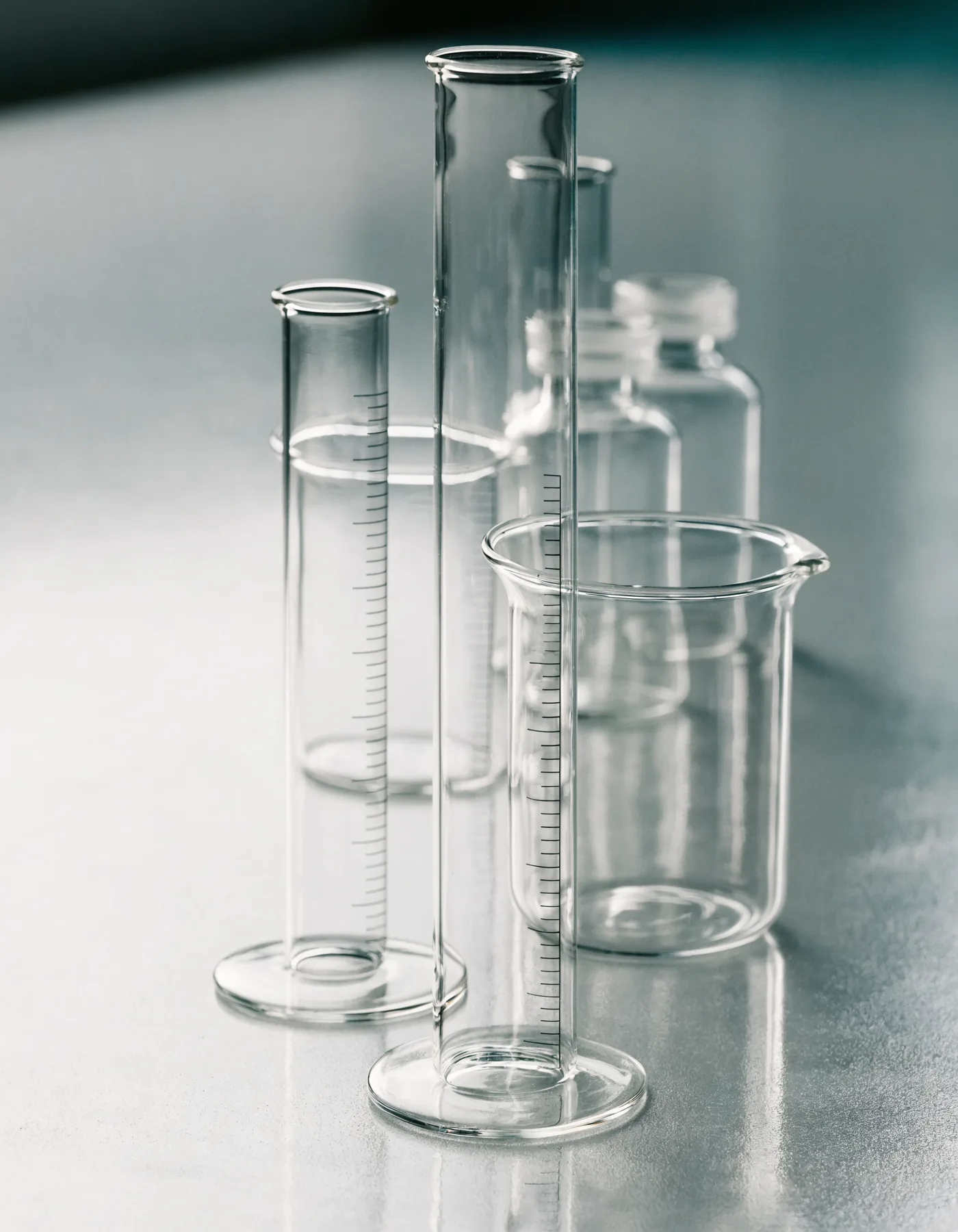
We treat glass as an engineered material, not a commodity. Our process controls the three variables that decide whether a vessel performs: composition, geometry, and the environment it is finished in.
We work exclusively in 3.3 expansion borosilicate — the international reference for thermal-shock resistance and chemical inertness. Low alkali migration, predictable expansion, stable across repeated thermal cycling.
Vessels are washed, depyrogenated, and finished under filtered, positive-pressure airflow. Each lot carries a batch record from anneal through final inspection, so traceability never breaks.
Orders are packed to survive transit, not just the warehouse. Foam-seated trays, tamper-evident closures, and documented packing standards for refrigerated and ambient consignments alike.
Informational overview. Full specifications, dimensions, and grading notes are listed in the catalog.
Crimp-top and screw-thread formats in 2 mL–30 mL. Amber and clear, with matched closures and inert liners. Supplied sealed, ready for a sterile field.
Serological pipettes, fixed-volume transfer tubes, and conical micro-tubes. Clear graduations, low static, certified nominal volumes per lot.
PTFE/silicone-faced septa and aluminium crimp seals engineered for repeat-access integrity and minimal coring.
Nitrile gloves, lint-free wipes, and 70% USP-grade isopropyl presentations for maintaining a clean working field.
Short, practical references on materials science, sterility practice, and storage — written for people who run laboratories.
Why 3.3 borosilicate is the reference standard for laboratory vessels — thermal-shock resistance, chemical inertness, and structural stability under repeated high-temperature cleaning.
Read note →A working SOP for holding a sterile field: laminar-flow practice, 70% USP isopropyl protocol, particulate control, and organising empty inventory without contamination drift.
Read note →How thermal fluctuation affects sealed vessels, why 2–8 °C ranges matter, and how to manage thermal bridging and cold-chain logistics over long holding periods.
Read note →